




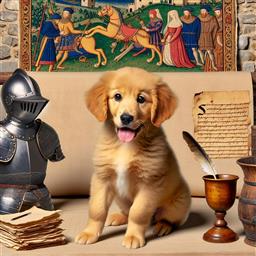
Welcome to a captivating journey back in time where we explore the unique and fascinating world of canine naming practices from the Middle Ages. This era, specifically the 1300s, was rich in cultural shifts and historical events that greatly influenced every aspect of life, including the manner in which our furry friends were named.
Within this collection, you will discover a plethora of distinct and meaningful names that were commonly given to dogs during this remarkable period. These names not only reflect the language, culture, and societal norms of the time, but also provide a glimpse into the roles and significance of dogs in 13th-century society. From names inspired by nature, religion, and mythology, to those derived from common occupations and personal characteristics, each name tells a unique story about the bond between humans and their canine companions in this bygone era.
Whether you're a history buff, a dog lover, or someone in search of a unique and meaningful moniker for your pet, this compilation is certain to captivate your interest. So, let's delve into the rich tapestry of the past and uncover the charm and history of these ancient dog names.
Names
| Name | Reason to Choose |
|---|---|
| Adelaide | Named after a famous queen of Italy |
| Aethelred | Aethelred, a royal name, would be fitting for a noble and regal dog |
| Aethelstan | Aethelstan, a king's name, would be fitting for a dog with a noble and commanding presence |
| Agnes | A popular name among noblewomen during this era, it would suit a regal canine |
| Alfred | After Alfred the Great, a revered English king |
| Anselm | After Saint Anselm, a famous theologian |
| Arnold | This name was common among 13th-century knights, making it a strong name for dogs |
| Aubrey | Common in the 13th Century due to popularity among the nobility |
| Avelina | Avelina, a common female name during this period, would suit a sweet and gentle dog |
| Baldwin | Many noble men were named so during this period |
| Bartholomew | An archbishop during this time bore this name, would be fitting for a wise old dog |
| Beatrice | Dante's muse in his famous Divine Comedy |
| Benedict | After Saint Benedict, patron saint of Europe |
| Berengar | Related to Germanic nobility of the time |
| Bertilda | Bertilda, a common female name, would be perfect for a sweet and gentle dog |
| Bertrand | Named after Bertrand de Got, Pope Clement V |
| Bevis | Drawn from the 13th Century Arthurian legend of 'Sir Bevis of Hampton' |
| Blanche | As a common name for princesses of this time, a fitting name for a pure white dog |
| Bridget | Bridget was a common name for women, often associated with virtue and purity |
| Bruno | A name of Germanic origin, it was common in the 13th-century, making it suitable for a strong, robust dog |
| Cecilia | A common saint's name in the 13th century |
| Clara | Bearing the name of a 13th-century saint, it's a fitting name for a kind-hearted dog |
| Clovis | Derived from Frankish kings, prevalent in the 13th Century |
| Constance | Reminiscent of the virtue names popular in medieval times |
| Cuthbert | Cuthbert, a name often given to religious figures, would be an amusing choice for a serious or devout dog |
| Cynewulf | Cynewulf, a poet's name, would be suitable for a creative and imaginative dog |
| Diana | A common name among noblewomen, fitting for a dignified and elegant dog |
| Drogo | Popularized by the character Drogo de la Beuvrière in 13th Century literature |
| Duncan | A Scottish king bore this name, making it a regal choice for a dog |
| Dunstan | Dunstan, a saint's name, would be ideal for a devout and serious dog |
Groups
Geographical Names
Many place names in the 13th century can make unique and interesting names for pets.
| Name | Description |
|---|---|
| Amsterdam | The Dutch city was established as a fishing village in the Middle Ages |
| Antwerp | Named after the wealthy Flemish city of the Middle Ages |
| Avignon | This French city was an important hub in the 13th century |
| Baghdad | The city was a significant center of the Islamic Golden Age |
| Bristol | The English city was a major port and economic center during this time |
| Cairo | After the Egyptian city that was a pinnacle of learning during this time |
| Cologne | After the German city that was a major trade center |
| Cordova | After the Spanish city known for its thriving intellectual center |
| Cusco | The city was the historic capital of the Inca Empire |
| Damascus | After the important cultural and economic city during the 13th century |
| Dublin | Named after the Irish city that was a major center of commerce |
| Granada | The city was the last stronghold of the Moors in Spain |
| Lisbon | Due to the importance of the city during the Portuguese Reconquista |
| Madrid | The capital of Spain was a growing city during the 13th century |
| Odessa | After the city that was a significant trade hub on the Black Sea |
| Oslo | The Norwegian city was a significant trade center during the Middle Ages |
| Pisa | Honoring the city known for its iconic leaning tower |
| Rome | After the city that was the heart of the Roman Empire |
| Seville | Named for the city that was a significant cultural center |
| Siena | The Italian city was a major trade crossroads during this time |
| Toledo | Named after the Spanish city known for its multicultural history |
| Venice | Named after the prominent Italian city in the 13th century |
| Verona | The city was a significant cultural center in northern Italy |
| Vienna | Named after the Austrian city known for its music and culture |
| York | A significant English city during the 13th century |
Names from Folklore
Folklore was a rich source of names in the 13th century, and such names can give your pet a name with a story behind it.
| Name | Description |
|---|---|
| Avalon | This is the legendary island featured in the Arthurian legend |
| Bedivere | A knight of King Arthur's Round Table, from Arthurian legend |
| Bors | Sir Bors was a character in Arthurian legend |
| Brangaine | A character from the Tristan and Iseult story, popular during the 13th century |
| Elaine | A character from Arthurian legend, known as Elaine the fair |
| Enide | A character from Arthurian legend, known as the wife of Erec |
| Erec | A character from Arthurian legend, known as Sir Erec |
| Excalibur | The legendary sword of King Arthur, another figure from Arthurian literature |
| Fenrir | A monstrous wolf from Norse mythology, known during the 13th century |
| Gaheris | A character from Arthurian legend, known as Sir Gaheris |
| Galahad | This name is from Sir Galahad, a knight of King Arthur's Round Table |
| Gareth | A character from Arthurian legend, known as Sir Gareth |
| Gawain | Sir Gawain was a character in Arthurian legend |
| Geraint | A character from Arthurian legend, known as Sir Geraint |
| Grainne | A character from Irish mythology, prevalent during the 13th century |
| Grendel | Drawn from Beowulf, an Old English epic poem that dates back to the early centuries |
| Guinevere | Guinevere was the queen of King Arthur, a character in Arthurian legend |
| Iseult | From the Tristan and Iseult tale, popular during the 13th century |
| Lancelot | This name originates from Arthurian legend, which was popularized in the 13th century |
| Merlin | The famous wizard from Arthurian tales was a popular figure in the 13th-century literature |
| Mordred | A character from Arthurian legend, known as a traitorous knight |
| Morgan | Morgan le Fay is a character from Arthurian legend |
| Odin | A significant deity in Norse mythology, known during the 13th century |
| Percival | Percival was a knight in the Arthurian legend |
| Tristan | An iconic character of the Tristan and Isolde legend, which was prevalent in the 13th-century literature |
Names from Royalty
The 13th century was a time of kings and queens, and their names can provide a regal touch for a pet.
| Name | Description |
|---|---|
| Adelaide | Adelaide of Burgundy, Duchess of Brabant, was a significant noblewoman |
| Alexander | Alexander III of Scotland was a prominent king during this era |
| Alfonso | Named after Alfonso X of Castile, a learned king of the 13th century |
| Beatrice | Beatrice of Burgundy was queen of Germany during this period |
| Berengaria | Berengaria of Castile was a queen consort of León and Castile |
| Constance | Constance of Sicily, a queen consort of the Holy Roman Empire, makes it a royal choice |
| Edward | Edward I of England reigned during the later part of this century |
| Eleanor | Eleanor of Provence was queen consort of England during this period |
| Elizabeth | Named after Elizabeth of Hungary, a 13th century queen |
| Ferdinand | Ferdinand III of Castile was a significant ruler of the era |
| Frederick | Frederick II, Holy Roman Emperor, was an iconic figure of the period |
| Henry | Henry III of England was a dominant figure in the 13th century |
| Isabella | Isabella II of Jerusalem ruled during this era, making it a royal dog name |
| Joan | Joan I of Navarre was a queen regnant of Navarre and queen consort of France |
| Ladislaus | Ladislaus IV of Hungary was a well-known king during this period |
| Louis | Inspired by Louis IX of France, a 13th century monarch |
| Margaret | Inspiration comes from Margaret of France, a queen consort of England |
| Matilda | Matilda of England, Duchess of Saxony, was a notable figure in the 13th century |
| Otto | Otto IV, Holy Roman Emperor, reigned in the early part of the century |
| Peter | Peter III of Aragon was a notable monarch in the 13th century |
| Philip | Philip III of France, known as Philip the Bold, was a prominent ruler |
| Rudolf | Rudolf I of Germany became the first Habsburg king in the 13th century |
| Stephen | Stephen V of Hungary was a king known for his efforts in centralization |
| Theobald | Theobald II of Navarre was a king and also count of Champagne |
| Yolanda | Yolanda of Lusignan was a queen consort of Jerusalem |
Religious Names
The 13th century was a period of great religious significance, and many names inspired by religious figures were popular.
| Name | Description |
|---|---|
| Abelard | Named after Peter Abelard, a notable theologian in the 12th and 13th century |
| Albertus | In reference to Albertus Magnus, a renowned theologian and saint |
| Ambrose | In honor of Saint Ambrose, one of the four Latin Doctors of the Church |
| Anselm | After Anselm of Canterbury, a notable theologian, philosopher, and saint |
| Aquinas | Named after Thomas Aquinas, a significant theologian and philosopher |
| Augustine | Named after Saint Augustine of Hippo, one of the four Latin Doctors of the Church |
| Beatrice | Named after Beatrice of Nazareth, a notable mystic and theologian |
| Benedict | Named after Saint Benedict, the founder of Western monasticism |
| Bernard | Named after Saint Bernard of Clairvaux, a renowned mystic and theologian |
| Bonaventure | In honor of Saint Bonaventure, a prominent theologian and philosopher |
| Catherine | In honor of Catherine of Siena, a notable mystic and theologian |
| Chaucer | Named after Geoffrey Chaucer, the author of 'The Canterbury Tales' |
| Clare | In honor of Saint Clare of Assisi, a follower of Saint Francis |
| Dante | After Dante Alighieri, who wrote 'The Divine Comedy', a major work of the Middle Ages |
| Dominic | A tribute to Saint Dominic, who founded the Dominican Order in the 13th century |
| Duns | After John Duns Scotus, a significant theologian and philosopher |
| Francis | Honoring Saint Francis of Assisi, a popular saint from the 13th century |
| Gregory | After Pope Gregory IX, who served in the 13th century |
| Hildegard | After Hildegard of Bingen, a renowned mystic, writer, and theologian |
| Ignatius | In honor of Saint Ignatius of Loyola, the founder of the Jesuits |
| Innocent | In reference to Pope Innocent III, a significant figure in the 13th century |
| Jerome | Named after Saint Jerome, one of the four Latin Doctors of the Church |
| John | After Saint John the Evangelist, one of the apostles of Jesus |
| Julian | After Julian of Norwich, a renowned mystic and theologian |
| Teresa | In honor of Saint Teresa of Avila, a prominent mystic and theologian |
Names from Literature
Many literary works from the 13th century offer excellent name options that reflect the culture and language of the time.
| Name | Description |
|---|---|
| Albertus | Albertus Magnus was a famous philosopher and theologian in the 13th Century |
| Aquinas | Thomas Aquinas was a significant theologian and philosopher in the 13th Century |
| Beatrice | Beatrice was Dante's love interest in his famous Divine Comedy |
| Boccaccio | A prominent Italian writer in the 13th Century |
| Bonaventure | Bonaventure was a 13th-century Italian scholar |
| Bunyan | John Bunyan was a 13th-century English writer and preacher |
| Canacee | Canacee is a character in Chaucer's 'The Legend of Good Women' |
| Chaucer | A homage to Geoffrey Chaucer, an English author who lived during the late 13th Century |
| Dante | Inspired by Dante Alighieri, a prominent Italian poet in the 13th Century |
| Decameron | Inspired by Boccaccio's 'The Decameron', a famous 13th-century literary work |
| Eckhart | Meister Eckhart was a theologian, philosopher, and mystic born in the late 13th Century |
| Fiammetta | A character in the Decameron, a 13th-century collection of novellas |
| Giotto | A famous Italian painter and architect during the late 13th century |
| Griselda | Griselda is a patient and obedient character in Chaucer's 'The Clerk's Tale' |
| Hildegard | Hildegard of Bingen was a renowned writer, composer, philosopher, and mystic in the late 12th and early 13th Century |
| Kublai | Kublai Khan was a Mongolian leader visited by Marco Polo |
| Laura | Laura is Petrarch's muse in his collection of Italian sonnets |
| Marco | Inspired by Marco Polo, the famous Venetian explorer of the 13th Century |
| Petrarch | An Italian scholar during the 13th century |
| Polo | The last name of 13th Century Venetian explorer Marco Polo |
| Rumi | A famous Persian poet of the 13th century |
| Sappho | Sappho was a Greek poetess referred to by Dante in his works |
| Shams | Shams Tabrizi was a spiritual instructor of Rumi |
| Siger | Siger of Brabant was a famous 13th-century philosopher |
| Virgil | Dante's guide through Hell and Purgatory in the Divine Comedy |