




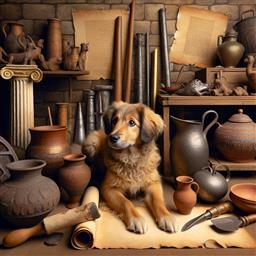
Delving into the fascinating realm of antiquity, we uncover the charming tradition of naming our four-legged companions that dates back centuries. The period of interest is the 2nd Century AD, a time where civilization witnessed significant growth in various aspects. The dog, man's loyal friend, was not left behind and the names given to these treasured pets during this era reflect the rich cultural and historical depth of the period.
As we explore these unique and distinctive names, it's interesting to note how they often echo the lifestyle, values, and beliefs of the people during the 2nd Century. Rooted in languages such as Latin and Greek, these names offer a captivating glimpse into the past. Each name carries a story, an essence of the world as it was during the time. Be prepared to be transported back in time and relish in the ancient sophistication that these pet names embody.
This page is dedicated to honoring these historical names and their origins. It serves as a guide for those who appreciate the beauty of antiquity and wish to bestow upon their pets a name that is not only unique, but also carries the weight of historical significance. Whether you're a history enthusiast, a dog lover, or simply someone in search of a meaningful name for your new pet, this collection of 2nd Century dog names will surely inspire and intrigue.
Names
| Name | Reason to Choose |
|---|---|
| Achilles | A Greek hero of the Trojan War |
| Aelia | Derived from a prominent Roman family name |
| Aemilia | Aemilia was a prominent family in ancient Rome, making it a fitting name for a noble canine companion |
| Ajax | A hero from Greek mythology, known for his strength and courage |
| Antonius | Named after Marcus Antonius, a notable Roman politician |
| Aphrodite | The Greek goddess of love and beauty |
| Apollo | Named after the Greco-Roman god of light, healing, and prophecy |
| Aquila | It's the Latin word for 'eagle', a symbol of strength and power in the 2nd century |
| Ares | Named after the Greek god of war, known to Romans as Mars |
| Argus | A character from Greek mythology with a hundred eyes |
| Artemis | Named after the Greek goddess of the hunt |
| Athena | The Greek goddess of wisdom, courage, and warfare |
| Atticus | This Roman name, belonging to a famous philosopher, is suitable for a dog with a calm and thoughtful nature |
| Augustus | The first Roman Emperor's name |
| Aurelia | A nod to the Aurelia family in Rome |
| Aurelius | It was an aristocratic family name in ancient Rome |
| Bacchus | The Roman god of wine |
| Balbus | This Roman name means 'stutter', a humorous and endearing name for a dog that has a unique bark |
| Bellatrix | This Latin word for 'female warrior' is fitting for a strong dog |
| Brutus | Named after a famous Roman statesman, this name is perfect for a dog with a strong and dignified demeanor |
| Caecilia | This Roman family name, associated with music, is perfect for a dog with a melodious bark |
| Caelius | This name comes from a prominent hill in Rome, suitable for a dog with a strong, sturdy nature |
| Caesar | It was a title used by Roman emperors |
| Caligula | Named after the Roman Emperor, Caligula |
| Cassia | This Roman family name, meaning 'empty, vain', would be a humorous name for a dog with a playful and energetic personality |
| Cassius | A tribute to Cassius Dio, a Roman historian |
| Cato | Named after a famous Roman statesman known for his integrity, this name is perfect for a dog with a loyal and honest nature |
| Catullus | A reference to the Roman poet, Catullus |
| Cicero | Named after the Roman philosopher |
| Claudia | Derived from the Roman family name, Claudia |
Groups
Ancient City Names
There were many ancient cities during the 2nd century. These names could provide a sense of history and culture.
| Name | Description |
|---|---|
| Alexandria | A powerful city in Egypt named after Alexander the Great |
| Antioch | An important city of the ancient Roman Empire, located in modern-day Turkey |
| Athens | Athens, the capital of Greece, is a city that thrived in ancient times |
| Babylon | A city from ancient Mesopotamia, one of the earliest civilizations |
| Byzantium | Early name for Istanbul, a crucial city in the 2nd Century |
| Cappadocia | An area in Turkey, known for its unique geological, historical, and cultural features |
| Carthage | Ancient city-state on the coast of Tunisia, a major power during the 2nd Century |
| Cnidus | An ancient Greek city in Anatolia, known for its medical school |
| Corinth | An ancient city in Greece, famous for its architectural and cultural influence |
| Crete | The largest island in Greece, known for its ancient Minoan civilization |
| Cyrene | An ancient Greek and Roman city in Libya, known for its temple of Apollo |
| Delphi | An important ancient Greek city, known for its oracle |
| Ephesus | Known for its Temple of Artemis, one of the Seven Wonders of the Ancient World |
| Hierapolis | An ancient city in Phrygia, known for its thermal springs |
| Memphis | An ancient city of Egypt, known for its temples and pyramids |
| Mycenae | An archaeological site in Greece, once a major center of Greek civilization |
| Olympia | An ancient Greek city, known for its Olympic games |
| Pergamon | An influential city-state in ancient Greece |
| Pompeii | An ancient Roman city, known for being preserved under volcanic ash |
| Rhodes | An island city in Greece, known for the Colossus of Rhodes |
| Roma | This name is derived from the capital of Italy, Rome, which has a rich history dating back to the 2nd Century |
| Sparta | Coming from the warrior city of ancient Greece |
| Syracuse | An ancient city on the island of Sicily, known for its rich Greek history |
| Thebes | Thebes was a significant city in ancient Egypt |
| Troy | Famous ancient city, known for the legendary Trojan War |
2nd Century Saints Names
Many saints lived during the 2nd century. These names can represent faith and virtue.
| Name | Description |
|---|---|
| Anicetus | Named after Pope Anicetus, who led the Church in the mid-2nd century |
| Apollinaris | Derived from Apollinaris Claudius, a Greek apologist from the 2nd century |
| Aristides | Originates from Aristides of Athens, a 2nd century Christian apologist |
| Athenagoras | Named after Athenagoras of Athens, an early Christian apologist |
| Clement | Attributed to Saint Clement of Alexandria, a leading figure in early Christian theology |
| Eleutherius | Named after Pope Eleutherius, a 2nd-century leader of the Church |
| Hermas | Inspired by Hermas of Rome, who was a Christian author during this period |
| Hyginus | Originates from Pope Hyginus, the head of the Church in the mid-2nd century |
| Ignatius | Named after Ignatius of Antioch, a well-known saint in the 2nd century |
| Irenaeus | This is the name of a prominent Christian theologian from the 2nd century |
| Justin | A name inspired by Justin Martyr, a Christian apologist from the 2nd century |
| Melito | Derived from Melito of Sardis, a Christian bishop and apologist from the 2nd century |
| Montanus | Inspired by Montanus, a Christian movement leader in the 2nd century |
| Pantenus | Named after Pantenus, a Christian theologian who was a missionary to India |
| Papias | Associated with Papias of Hierapolis, an early Christian bishop |
| Pinytus | Inspired by Pinytus, a Christian bishop who wrote notable letters to Dionysius of Corinth |
| Polycarp | This name is derived from Saint Polycarp, who was a bishop in the 2nd century |
| Pothinus | Derived from Pothinus of Lyon, a Christian bishop in the 2nd century |
| Quadratus | A name derived from Quadratus of Athens, a 2nd-century Christian apologist |
| Soter | Attributed to Pope Soter, the leader of the Church during the mid-2nd century |
| Symphorosa | Derived from Saint Symphorosa, a Christian martyr from the 2nd century |
| Telesphorus | Inspired by Pope Telesphorus, who led the Church in the 2nd century |
| Valentine | Attributed to Saint Valentine, a Christian martyr from this period |
| Victor | Inspired by Pope Victor I, a prominent figure in the Church during the 2nd century |
| Zephyrinus | Inspired by Pope Zephyrinus, who led the Church at the turn of the 3rd century |
Ancient Gladiator Names
Gladiators were popular during the 2nd century. These names can symbolize strength and courage.
| Name | Description |
|---|---|
| Achilles | A name derived from the famous Greek hero of the Trojan War, embodying strength and bravery |
| Ajax | A Greek mythological hero known for his courage and fierceness in battle |
| Ares | The Greek god of war, representing strength and courage |
| Atlas | A Titan in Greek mythology who was condemned to hold up the sky for eternity, symbolizing endurance |
| Brutus | A significant figure in the Roman Republic who was known for his courage |
| Caesar | A title used by Roman and Byzantine emperors, symbolizing power and leadership |
| Cassius | An iconic Roman military leader, politician, and historian of the Roman Republic |
| Cato | From a Roman statesman known for his integrity and moral righteousness |
| Commodus | This name is derived from a Roman Emperor who fancied himself a reincarnation of Hercules and often fought in the arena as a gladiator |
| Crixus | Inspired by a Gallic gladiator and military leader in the Third Servile War |
| Draco | A name that means 'dragon' in Latin, signifying power and fearlessness |
| Gannicus | A Celtic gladiator who played a prominent role in the slave uprising against the Roman Republic |
| Hercules | After the Roman adaptation of the Greek demigod Heracles, known for his strength and numerous far-ranging adventures |
| Icarus | Borrowed from Greek mythology, signifying daring and courage |
| Leonidas | A Spartan king known for his heroic stand against the Persian army |
| Mars | The Roman god of war, signifying bravery and fierceness |
| Maximus | The Latin term for 'greatest' was often used to denote powerful gladiators |
| Nero | A Roman Emperor known for his tyranny, signifying strength and command |
| Orion | Named after a giant huntsman in Greek mythology, symbolizing strength and agility |
| Otho | From a Roman Emperor who was known for his brief and tumultuous reign |
| Phoenix | A mythical bird that symbolizes rebirth and resilience |
| Spartacus | This name comes from a gladiator who led a major slave uprising against the Roman Republic |
| Tiberius | A Roman Emperor noted for his military achievements and authoritarian rule |
| Titus | A Roman Emperor renowned for his military triumphs |
| Vitus | A Christian saint and martyr, symbolizing faith and fortitude |
Greek Philosophers Names
The 2nd century was a time of great philosophers in Greece. Their names would give dogs a sense of wisdom and knowledge.
| Name | Description |
|---|---|
| Anaximander | Named after the early Greek philosopher who postulated the concept of Apeiron |
| Antisthenes | This name is inspired by the founder of Cynic philosophy |
| Archimedes | Named after the ancient Greek mathematician and inventor |
| Aristotle | The moniker comes from a revered philosopher of ancient Greece, who tutored Alexander the Great |
| Democritus | Reflects the name of the ancient philosopher famous for his atomic theory of the universe |
| Diogenes | Named after the Greek philosopher who founded Cynicism |
| Empedocles | The moniker is inspired by the philosopher-scientist known for his theory of the four classical elements |
| Epicurus | The name is drawn from the Greek philosopher who established the school of philosophy known as Epicureanism |
| Eratosthenes | The name comes from the Greek mathematician who measured the Earth's circumference |
| Euclid | This name mirrors that of the Greek mathematician, often referred to as the founder of geometry |
| Eudoxus | Named after the Greek astronomer and mathematician who contributed to the theory of proportion |
| Gorgias | The name originates from the Sophist, rhetorician, and philosopher |
| Heraclitus | The source of this name is a pre-Socratic philosopher known for his doctrine of change being central to the universe |
| Hipparchus | The moniker is inspired by the Greek astronomer, geographer, and mathematician |
| Hippocrates | Named after the ancient Greek physician, often referred to as the father of medicine |
| Hypatia | This name is inspired by the female philosopher, astronomer, and mathematician from Alexandria |
| Parmenides | Reflects the name of the philosopher who is known for his doctrine that reality is unchanging |
| Plato | This name mirrors that of the famous Greek philosopher who was a student of Socrates |
| Protagoras | This is the name of the ancient Greek philosopher known as the first and greatest of the Sophists |
| Ptolemy | The name is borrowed from the Greek mathematician, astronomer, and geographer |
| Pythagoras | Named after the ancient Greek thinker known for his theorem in geometry |
| Socrates | The dog shares a name with the seminal Greek philosopher known for his contributions to ethics |
| Thales | Named after the founder of natural philosophy in ancient Greece |
| Xenophon | Derived from the name of a Greek philosopher, historian, and soldier |
| Zeno | This comes from the founder of the Stoic school of philosophy |
Roman Emperor Names
Many emperors ruled during the 2nd century, and their names could serve as unique and historical dog names.
| Name | Description |
|---|---|
| Antoninus | Emperor Antoninus Pius was known for his peaceful reign |
| Aurelian | Aurelian is credited with ending the Crisis of the Third Century |
| Caracalla | Caracalla is known for granting Roman citizenship to all free men in the Empire |
| Carus | Carus was a distinguished military leader who died under mysterious circumstances |
| Claudius | Claudius II was known for his victories against the Goths |
| Commodus | Commodus' eccentric rule was depicted in the movie Gladiator |
| Decius | Decius initiated the first empire-wide persecution of Christians |
| Elagabalus | Elagabalus's rule was marked by eccentric and decadent behavior |
| Gallienus | Gallienus is considered the founder of the Middle Roman Empire |
| Gallus | Gallus was known for his harsh rule and tragic end |
| Geta | Emperor Geta's rule was overshadowed by his elder brother Caracalla |
| Gordian | A nod to Gordian III, the youngest man to assume the throne |
| Hadrian | Named after Emperor Hadrian who built Hadrian's Wall in Britannia |
| Lucius | An ode to Lucius Verus, co-emperor with Marcus Aurelius |
| Macrinus | Macrinus was the first emperor who was neither a senator nor of senatorial family |
| Marcus | In memory of Marcus Aurelius, a philosopher king and a symbol of wisdom |
| Maximinus | Maximinus Thrax was the first barracks-emperor of Rome |
| Philip | Philip the Arab was the first emperor from the Arabian Peninsula |
| Probus | Probus was known for his successful military campaigns |
| Quintillus | Quintillus's rule was brief but honorable |
| Septimius | A tribute to Septimius Severus, founder of the Severan dynasty |
| Severus | This name pays homage to Severus Alexander, known for his attempts to foster religious unity |
| Tacitus | Tacitus was known for his attempts to restore the Senate's authority |
| Trajan | A homage to Emperor Trajan, known for his public building programs and military campaigns |
| Valerian | Valerian was the first emperor to be captured by an enemy force |