



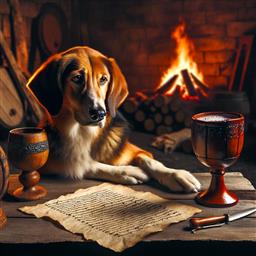
Welcome to a unique compilation dedicated to the world of canine nomenclature, drawn from a time period steeped in history and rich in culture - the 8th Century. This was a time when the Byzantine Empire was in its glory, Charlemagne was crowned king of the Franks and Lombards, and the Islamic Golden Age was in its bloom. It was an era that straddled the ancient and the medieval world, which is reflected in the distinctive and characterful names of that period.
Our collection captures the essence of this vibrant era, presenting you with an array of names that were commonly used for dogs during these centuries. These names, redolent with historical significance, can add a touch of antiquity and uniqueness to your beloved pet. Rooted in various cultures and languages, these names not only serve as a nod to the past but also stand out in the crowd of contemporary pet names. Whether you're a history buff, a lover of ancient cultures, or simply on the lookout for a unique and meaningful name for your new furry friend, our catalogue promises to offer something special and fitting.
So, journey with us back in time as we explore the fascinating world of dog names from the 8th Century. We hope that within this treasure trove, you will discover a name that resonates with you and provides your canine companion with a moniker as unique and special as they are.
Names
| Name | Reason to Choose |
|---|---|
| Aelfric | Aelfric was a common name in the 8th century |
| Aethel | Old English for 'noble' |
| Aethelbald | Aethelbald was a common name in the 8th century |
| Aethelberht | An East Anglian king |
| Aethelheard | An Archbishop of Canterbury |
| Aethelstan | Aethelstan is a name from the 8th century |
| Aethelwulf | Aethelwulf was a common name in the 8th century |
| Alfred | Alfred was a popular 8th century Anglo-Saxon name |
| Beda | Named after the famous 8th-century historian |
| Beorhtwald | An Archbishop of Canterbury |
| Beorhtwulf | Beorhtwulf is derived from Old English name popular in the 8th century |
| Beowulf | A heroic character from an Old English epic poem |
| Bertric | Bertric is a name from the 8th century |
| Bertwald | An Archbishop of Canterbury |
| Cedric | Cedric was a popular name during the 8th century |
| Cenred | An underking in Mercia |
| Ceolred | Name of a Mercian king |
| Ceolwulf | Ceolwulf was a common name in the 8th century |
| Coenred | A Mercian king |
| Cuthbeorht | A common name in the 8th Century, meaning 'famous and bright' |
| Cuthbert | Name of a well-known saint from this period |
| Cuthred | A West Saxon king |
| Cuthwine | Derived from Old English elements meaning 'famous friend' |
| Cwen | Old English for 'queen' |
| Cwenburh | A woman who set up a monastery |
| Cyneburg | A common female name during the period, meaning 'royal protection' |
| Cyneburh | A woman who set up a monastery |
| Cyneheard | An ealdorman in the kingdom of Wessex |
| Cynehelm | An ealdorman of Kent |
| Cynewulf | An Anglo-Saxon poet's name |
Groups
Celtic Names
Celtic culture was prominent during the 8th century. These names could reflect the dog's strength or beauty.
| Name | Description |
|---|---|
| Aedan | It's Celtic for 'little fire', making it fitting for a fiery spirited pup |
| Bradan | This Celtic name meaning 'salmon' is an excellent choice for a swimming lover dog |
| Caelan | A name of Celtic origin meaning 'powerful warrior' would suit a protective dog |
| Daire | Means 'fruitful, fertile' in Celtic, a great option for a productive hunting dog |
| Eoghan | This name means 'born of the yew tree', a symbol of resilience in Celtic mythology |
| Fergus | A strong Celtic name for a dog, symbolizing strength and virility |
| Garvan | This Celtic name meaning 'rough' could be suitable for a rugged outdoor dog |
| Hagan | Meaning 'young', a fitting name for a playful and young-at-heart pup |
| Ivor | A Celtic name meaning 'archer', perfect for a hunting dog with sharp instincts |
| Jarlath | A name of a saint in Celtic tradition, fitting for a dog with a gentle soul |
| Kael | A Celtic name meaning 'slender', perfect for a sleek and agile dog |
| Lugh | Named after a Celtic god known for his skills and crafts |
| Mael | A name of Celtic origin meaning 'prince', suitable for a regal and dignified dog |
| Naoise | This name is associated with a tragic hero in Celtic mythology |
| Oisin | A name meaning 'little deer', suitable for a gentle and cautious dog |
| Padraig | The Celtic form of Patrick, a suitable name for a dog with a noble spirit |
| Quinlan | A Celtic name meaning 'fit and strong', perfect for a robust and energetic dog |
| Ronan | A name meaning 'little seal', ideal for a dog who loves water |
| Seamus | The Celtic form of James, a traditional name for a loyal companion |
| Taran | This Celtic name meaning 'thunder' could be suitable for a loud and boisterous dog |
| Uisneach | Named after a mythic mountain in Celtic beliefs, perfect for a mountain-loving dog |
| Vaughan | A name of Celtic origin meaning 'small', fitting for a petite dog |
| Wynn | Meaning 'fair, white', a perfect name for a light-colored dog |
| Xylon | A unique Celtic name meaning 'forest', great for a nature-loving dog |
| Yestin | The Celtic form of Justin, a strong and classic name for a dog |
Old English Names
Old English was spoken during the 8th century. Such names could give the dog a traditional and unique name.
| Name | Description |
|---|---|
| Aelfric | Old English for 'elf ruler', popular during the 8th century |
| Aethelred | An ancient English name meaning 'noble counsel' |
| Aldred | An Old English name meaning 'old counsel' |
| Beowulf | An epic hero from Old English literature |
| Beric | A popular 8th-century name, meaning 'grain farm' |
| Cenric | A popular 8th-century name, meaning 'bold ruler' |
| Ceolwulf | An ancient English name meaning 'keel wolf' |
| Cynewulf | An 8th century poet, meaning 'kin wolf' |
| Eadric | An Old English word meaning 'wealthy ruler' |
| Ealdred | A popular name in the 8th century, meaning 'old counsel' |
| Egbert | Commonly used in the 8th century, means 'bright edge' |
| Godric | Ancient English name denoting 'power of god' |
| Hereward | Means 'guardian of the army', a popular choice back then |
| Hrothgar | An Old English name from Beowulf, meaning 'glorious spear' |
| Leofric | A common 8th-century name, meaning 'beloved ruler' |
| Leofwin | A popular name in the 8th century, meaning 'beloved friend' |
| Ordgar | An ancient English name meaning 'spear point' |
| Osric | An Old English name meaning 'god ruler' |
| Sigebert | A common name in the 8th century, meaning 'victory bright' |
| Sigeric | Old English name meaning 'victory ruler' |
| Theodric | A popular 8th-century name, meaning 'people ruler' |
| Thurstan | Means 'Thor's stone', a popular choice back then |
| Wiglaf | A character from Beowulf, means 'war remnant' |
| Wulfric | An Old English name meaning 'wolf ruler' |
| Wulfstan | A popular name in the 8th century, meaning 'wolf stone' |
Biblical Names
The Bible was widely spread during the 8th century. Choosing a biblical name could reflect the dog's virtue or character.
| Name | Description |
|---|---|
| Abel | In the Bible, Abel was the second son of Adam and Eve |
| Amos | Amos was an Old Testament prophet |
| Caleb | Caleb is a figure from the Old Testament who was noted for his faithfulness to God |
| Elijah | Elijah serves as a prophet in the Old Testament |
| Ezekiel | Biblically, Ezekiel was a prophet during the Babylonian exile |
| Ezra | Ezra is a scribe and priest in the Old Testament |
| Gideon | From the Old Testament, Gideon was a judge of Israel |
| Isaac | Originating from the Old Testament, Isaac was the son of Abraham and Sarah |
| Isaiah | Isaiah was a major prophet in the Old Testament |
| Jeremiah | Jeremiah was one of the prophets from the Old Testament |
| Job | Job is the central figure of the Book of Job in the Bible |
| Jonah | Jonah was a prophet in the Old Testament who was swallowed by a large fish |
| Josiah | Josiah was a king of Judah in the Old Testament |
| Judah | Judah was one of the twelve sons of Jacob in the Old Testament |
| Levi | Levi, in the Bible, was the third son of Jacob and Leah |
| Malachi | Malachi was one of the minor prophets in the Old Testament |
| Micah | Micah was an Old Testament prophet |
| Moses | Moses is a significant figure in the Bible who led the Israelites out of Egypt |
| Nehemiah | Nehemiah, in the Bible, was a leader of the Jews who returned from exile |
| Noah | Noah, from the Old Testament, famously built an ark to survive a great flood |
| Obadiah | Obadiah was a prophet in the Old Testament |
| Samson | Samson was a judge of Israel in the Old Testament, known for his supernatural strength |
| Samuel | Samuel was a significant prophet in the Old Testament |
| Seth | Biblically, Seth was the third son of Adam and Eve |
| Solomon | King Solomon is a significant figure in the Old Testament |
Historical Ruler Names
The 8th century was marked by iconic rulers. Using their names could add a regal touch to the dog's persona.
| Name | Description |
|---|---|
| Abbas | Named after Al-Abbas, the founder of the Abbasid Caliphate in the 8th century |
| Alfonso | This commemorates Alfonso II of Asturias, a ruler in Spain during the 8th century |
| Anastasios | Anastasios II was a Byzantine Emperor who ruled in the 8th century |
| Bertrada | Bertrada of Laon was a Queen of the Franks in the 8th century |
| Carloman | Carloman I was a King of the Franks in the 8th century |
| Charlemagne | This is derived from Charles the Great, a king who ruled much of western Europe in the 8th century |
| Constantine | Constantine V was a Byzantine Emperor in the 8th century |
| Desiderius | Named after Desiderius, the last king of the Lombard Kingdom in the 8th century |
| Eadberht | Eadberht was a King of Northumbria during the 8th century |
| Egbert | Egbert of Wessex was a prominent English monarch in the 8th century |
| Harun | Named after Harun al-Rashid, a notable caliph from the 8th century |
| Hisham | Hisham was a caliph of the Umayyad Caliphate in the 8th century |
| Irene | It is inspired from Irene of Athens, a Byzantine empress during the 8th century |
| Justinian | Justinian II was a Byzantine Emperor during the 8th century |
| Leo | Named after Leo III the Isaurian, a Byzantine emperor who reigned in the 8th century |
| Odo | Odo of Aquitaine was a Duke in the 8th century |
| Offa | Offa, the King of Mercia, was a dominant figure in England during the 8th century |
| Pepin | This is a tribute to Pepin the Short, the King of the Franks in the 8th century |
| Ratchis | Ratchis was a King of the Lombards in the 8th century |
| Stephen | Stephen II was a Pope in the 8th century |
| Tassilo | Tassilo III was a Duke of Bavaria in the 8th century |
| Telerig | Telerig was a ruler of Bulgaria during the 8th century |
| Widukind | Widukind was a leader of the Saxons in the 8th century |
| Yazid | Yazid II was a caliph of the Umayyad Caliphate in the 8th century |
| Zachary | Zachary was a Pope in the 8th century |
Norse Mythology Inspired Names
During the 8th century, Norse mythology was prevalent. Dogs could be named after gods, goddesses, or mythological creatures.
| Name | Description |
|---|---|
| Aegir | This name pays homage to the Norse giant associated with the sea |
| Baldur | Inspired by the Norse god known for his beauty and goodness |
| Bragi | This name belongs to the Norse god of poetry and eloquence |
| Eir | Inspired by the Norse goddess known for her medical skills |
| Fenrir | Named after the monstrous wolf in Norse mythology |
| Forseti | Named after the Norse god of justice and reconciliation |
| Freya | Inspired by the Norse goddess of love and beauty |
| Frigg | This name has been derived from the Norse goddess of wisdom and foreknowledge |
| Garmr | Derived from the name of the hound that guards Hel's gate in Norse mythology |
| Heimdall | This name pays homage to the watchful and alert Norse god |
| Hod | This name pays tribute to the Norse god who was tricked into killing his brother Baldur |
| Idunn | This name belongs to the Norse goddess who is the keeper of apples and granter of eternal youth |
| Loki | Named after the cunning trickster god in Norse mythology |
| Mimir | The Norse mythology inspired name of the wise god of knowledge |
| Modi | This name is inspired by the Norse god known for his anger |
| Njord | This name has been inspired by the Norse sea god |
| Odin | Derived from the all-father god in Norse mythology |
| Ran | This name has been inspired by the Norse sea goddess |
| Sif | This name is derived from the Norse goddess known for her golden hair |
| Skadi | Named after the Norse goddess of winter and hunting |
| Sleipnir | This name belongs to Odin's eight-legged horse in Norse mythology |
| Thor | This name belongs to the Norse god of thunder |
| Tyr | This name is inspired by the brave Norse god of war |
| Ullr | This name is derived from the Norse god of archery and skiing |
| Vali | Inspired by the Norse god known for his revenge against Loki |